
Predictive AI vs. LLMs

The code is the easy part.

If your team is using an LLM (Claude, Gemini, or ChatGPT) to predict churn, LTV, or campaign performance, this page is for you. The 90-second video below shows what those tools skip and what it costs you in production.

~1 week from question to validated production model

Where prompt-built models fall apart

90 seconds on what Claude or ChatGPT gets right, and what they quietly skip.

Sounds familiar?

If you have already pointed an LLM at your data and asked for a churn or LTV model, you have probably hit at least one of these.

Your model answered the wrong question

"Predict churn" is not a real brief. Churn in 7 days and churn in 6 months produce two different models that point you toward two different actions. An LLM builds whatever you asked for, confidently, even when the framing is off.

A static answer for a business that won't sit still

Prompt-built models live on a snapshot of your data. They do not refresh, do not connect to your CRM, and do not flag the customer about to leave next Tuesday. Your business has already moved on. The model has not.

Nobody on the team can actually review the code

Production-grade ML code needs someone who can spot data leakage, overfitting, and unbalanced labels. Without that, you have a model that looks great in testing and quietly fails in production. Would you bet next quarter on code nobody fully understands?

What an LLM skips when you build a predictive model

Reliable prediction needs three things. An LLM gives you one of them. Pecan handles all three.

It won't frame your question, or understand your business

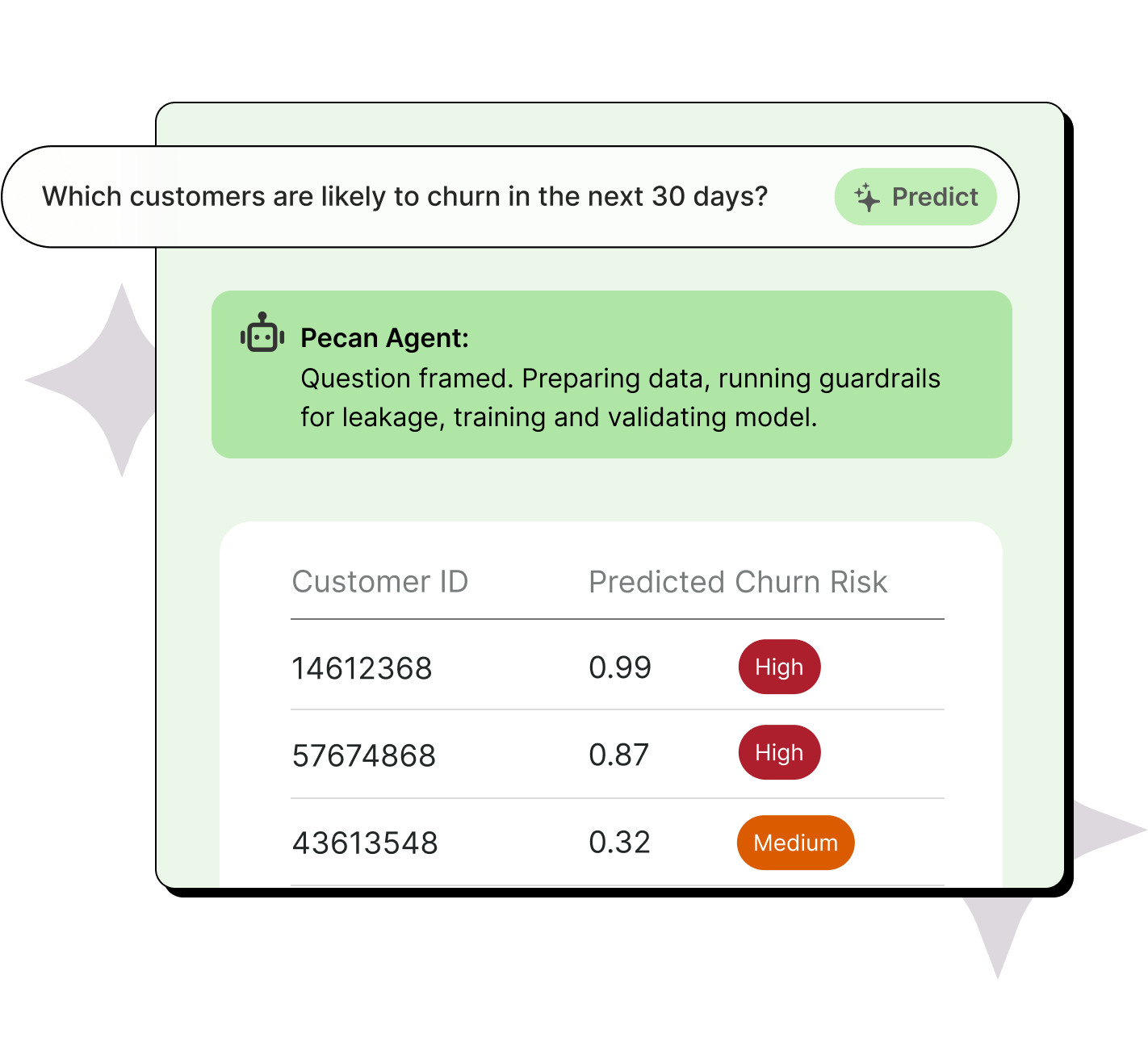
An LLM executes the request you typed. It doesn't know your customers, your data, or which time window actually matters, so it can't warn you that "predict churn" is too vague to act on. You find that out later, after the model has answered a question you never meant to ask. Pecan's agent sharpens vague intent into a precise question, and shows you what your data can support before anything gets built.

It won't validate your model or prevent leakage

Ask an LLM for feature engineering code and it will write some, fast. It won't check that code for data leakage, overfitting, or unbalanced labels, because it doesn't understand the context of your data. So the model looks great in testing and quietly falls apart in production. Pecan validates every model and runs leakage prevention by default, so what you ship is what you measured.

It won't deploy where you work

An LLM hands you a script and walks away. It doesn't push the prediction into Salesforce or HubSpot, it doesn't refresh on new data, and it doesn't run again tomorrow. The work of making it live, and keeping it live, lands back on you. Pecan deploys predictions where your team already works, keeps monitoring performance, and flags when retraining is needed.

How it works

Ask: Start with a business question

 “Which customers are likely to churn next quarter?” “What will this campaign’s ROAS be?”

01
Automate: Pecan builds the model

Data prep, feature engineering, validation. All automatic.

02
Validate: Get predictions you trust

Each prediction comes with confidence scores and plain-English explanations.

03
Deploy: Act where you work

Results flow directly into HubSpot, Salesforce, or your data warehouse.

04

Built for production

~1 week

from question to production model

32x

faster than traditional approaches

0

lines of code required

Company Size Medium
Industry Consumer Wellness
Pecan's predictions informed our marketing efforts, helping us reach out to the right customers and allocate spend in the right places
John Sherwin
CEO, Hydrant

If you need predictive, you need the right tool.

Book a 30-minute onboarding session. We'll build a tailored predictive model on your data. No commitment, no code.